 It's a matrix of symmetries spun round a sum over histories. An extrapolation of the law of conservation of weirdness upon particles upon fields with infinite degrees of freedom. For like the weather, with its fields of temperature and wind and like the orchestra, with fields of soft passages and abrupt chords; it presents a grand region of quantised influence. Quantum field theory persists as the most matured form of quantum mechanics; a regime of particles, groups and symmetries; a field formulation that has a value at every point in space and solutions that are nothing short of baffling. Its appeal to symmetries as an 'invariance under a specified group of transformations' means that some operation can be executed on a quantum system leaving it indiscernible from its starting state. For instance the standard model; which can be geometrically quantised in terms of fiber bundles and lie groups, has individual fibres or figures attached at every point in space-time each relating to a different type of particle. The resulting symmetry groups are U(1), consisting of circles at every spacetime point for electromagnetism, SU(2) for the weak interaction, SU(3) for the strong force and potentially Spin(1,3) for gravity. Some basic formalisms are QED; the field theory of electromagnetic vacuum perturbation along with QCD; the field theory of the strong force mediated by gluons upon quarks. QCD allows quarks to share confinement, colour charge and encounter asymptotic freedom at high energies (a paradoxical phenomenon that causes weaker attaction between quarks as distance increases). QED is quite distinct given its single charge and a less energetic response of photons to electric charge compared to the trinity of colour charges for quarks and the vigorous response of gluons to each other, making the prospects for a photon lightsaber bleak! Moreover, the precise calculation of the Lamb shift (a tiny spliting in energy values between the 2s and 2p states of the hydrogen atom) and the anomaly of the electron's magnetic dipole moment (the value of a particle that determines the force that it may release upon electric currents and the torque that a magnetic field will exert on it) are among the most accurate of predictions in quantum field theory. If you picture an electron dipped in a magnetic field, it's intrinsic spin gives it a magnetic moment producing an energy of interaction which is dependant on the angle between the direction of the imposed magnetic field and the electron's own magnetic field. Aligning the two fields will produce a low energy, opposing them will produce a high energy and at intermediary angles the energy level will differ between these values. So accurate these calculations are that in fact some common sense notions breakdown such as 'nothing'. Nothing becomes the lowest energy state of a physical theory, Maxwell's equations may describe the electric field in the classical sense but if we reduce its total energy to 0, it disappears and a vacuum is all that remains. The quantum field theory description however reveals a sea of fluctuations due to the uncertainty principle, a quantum 'vacuum' where virtual and anti-particles transiently pop in and out of existence from nothing from the instability of empty space. Such a redefinition provides the basis for explaining quantum phase transitions such as superconductivity expounded by the BCS theory. The idea that Cooper pairs or twins of electrons act distinctly from 'singlets' governed by the exclusion principle, they act in a way that resembles bosons, condensing into the same energy level leading to the inhibition of the collision reactions that cause resistance; thus causing a infinite flow of current. And above all, the magic of spontaneous symmetry breaking is an phenomenon worth mentioning whereby small, infinitesimal changes influencing a quantum system cause a sort of exhange between order and chaos resulting in a compromise. Basically like a pencil balanced on its tip which has symmetry in that it looks indistinguishable from its starting state if rotated along a vertical axis (an overall symmetry of the gravtitational field); but its instability causes the breaking of the symmetry and the pencil to collapse into an asymmetric horizontal state. Or like a Mexican sombrero?
Monday, 4 March 2013
Quantum Field Theory- A Matrix of Symmetries
It's a matrix of symmetries spun round a sum over histories. An extrapolation of the law of conservation of weirdness upon particles upon fields with infinite degrees of freedom. For like the weather, with its fields of temperature and wind and like the orchestra, with fields of soft passages and abrupt chords; it presents a grand region of quantised influence. Quantum field theory persists as the most matured form of quantum mechanics; a regime of particles, groups and symmetries; a field formulation that has a value at every point in space and solutions that are nothing short of baffling. Its appeal to symmetries as an 'invariance under a specified group of transformations' means that some operation can be executed on a quantum system leaving it indiscernible from its starting state. For instance the standard model; which can be geometrically quantised in terms of fiber bundles and lie groups, has individual fibres or figures attached at every point in space-time each relating to a different type of particle. The resulting symmetry groups are U(1), consisting of circles at every spacetime point for electromagnetism, SU(2) for the weak interaction, SU(3) for the strong force and potentially Spin(1,3) for gravity. Some basic formalisms are QED; the field theory of electromagnetic vacuum perturbation along with QCD; the field theory of the strong force mediated by gluons upon quarks. QCD allows quarks to share confinement, colour charge and encounter asymptotic freedom at high energies (a paradoxical phenomenon that causes weaker attaction between quarks as distance increases). QED is quite distinct given its single charge and a less energetic response of photons to electric charge compared to the trinity of colour charges for quarks and the vigorous response of gluons to each other, making the prospects for a photon lightsaber bleak! Moreover, the precise calculation of the Lamb shift (a tiny spliting in energy values between the 2s and 2p states of the hydrogen atom) and the anomaly of the electron's magnetic dipole moment (the value of a particle that determines the force that it may release upon electric currents and the torque that a magnetic field will exert on it) are among the most accurate of predictions in quantum field theory. If you picture an electron dipped in a magnetic field, it's intrinsic spin gives it a magnetic moment producing an energy of interaction which is dependant on the angle between the direction of the imposed magnetic field and the electron's own magnetic field. Aligning the two fields will produce a low energy, opposing them will produce a high energy and at intermediary angles the energy level will differ between these values. So accurate these calculations are that in fact some common sense notions breakdown such as 'nothing'. Nothing becomes the lowest energy state of a physical theory, Maxwell's equations may describe the electric field in the classical sense but if we reduce its total energy to 0, it disappears and a vacuum is all that remains. The quantum field theory description however reveals a sea of fluctuations due to the uncertainty principle, a quantum 'vacuum' where virtual and anti-particles transiently pop in and out of existence from nothing from the instability of empty space. Such a redefinition provides the basis for explaining quantum phase transitions such as superconductivity expounded by the BCS theory. The idea that Cooper pairs or twins of electrons act distinctly from 'singlets' governed by the exclusion principle, they act in a way that resembles bosons, condensing into the same energy level leading to the inhibition of the collision reactions that cause resistance; thus causing a infinite flow of current. And above all, the magic of spontaneous symmetry breaking is an phenomenon worth mentioning whereby small, infinitesimal changes influencing a quantum system cause a sort of exhange between order and chaos resulting in a compromise. Basically like a pencil balanced on its tip which has symmetry in that it looks indistinguishable from its starting state if rotated along a vertical axis (an overall symmetry of the gravtitational field); but its instability causes the breaking of the symmetry and the pencil to collapse into an asymmetric horizontal state. Or like a Mexican sombrero?
Thursday, 14 February 2013
Wittgenstein- The Philosophical Lexus
 He was the commissar to a philosophical rebuke. A sharp, witty and scintillating ideal of modern thought, an emissary of a linguistic and metaphysical atomism and the expounding of a landscape of unprecedented abstraction. For it was his the redefinition of philosophy and logical form and function that continues to form a pillar of which we attempt to circumvent and infer to the fullest of play. And it was his fetish for language that deployed a panorama beyond the topography of mere letters and symbols, one that placed the world and its state of affairs at the focal pivot rather than a temporal periphery. Ludwig Wittgenstein remains the embodiment of such an ideal, the clarification of thoughts and the expression of such thoughts via the universal medium of language and discourse. To the early Wittgenstein, the temporal world is not a landscape of mere objects and things; rather it is the ultimate extravagance of facts made differential by pictures. Pictures are thoughts, they are thoughts thread by the isomorphic arrangement of elements predicated on objects in the state of affairs; for the structure of reality mirrors the framework of language. Such an approach to philosophy foresees the 'limits of the world as the limits of language' and the profound realisation that in so far as pictures are concerned, they fail to describe logical form yet unless language really mirrored reality, it would become impossible for sentences to ever be sensible, coherent and complete. But to the later Wittgenstein, the picture metaphor is inverted upon its head and words ultimately become cast our thinking of what reality actually is. We cannot live in a realm independent of the conceptual toolbox of language, for their exists an inseparable contingency; a family resemblance whereby words deduce meaning not from an inherent essence but from a matrix of similarities. We then realise Wittgenstein's erasure of the picture metaphor, the notion that semantics arises from an associative relation between ideas in the head and the underlying Platonic essence. Meaning is just the by-product of a hypothetical language game lacking any real foundation or justification and to Wittgenstein it is the binding role of the philosopher to validate such a game with description. Verily it becomes impossible to separate oneself from the language game and superimpose, compare and contrast its successes, failures and shortcomings. Private language seems to circumvent this paradigm, by working from the centre of an individual outwards until one realises that private sensations alone are contingent upon external, societal criterions and negates the difference between thinking and actually using the private language soundly. And over the long haul it becomes rather appeasing and satiable to consider the musings of Wittgenstein as laws and constants of human language and behaviour, strung by the words yet envisaged by a picture.
Tuesday, 5 February 2013
Black Holes- A Fatal Attraction

Friday, 25 January 2013
Quantum Brain- Inside the Bits and Bytes of Consciousness
 Enter a world where the game is played by breaking the rules. One where uncertainty and entanglement reign while coherence and complementarity occupy the ultimate domain. A duality of particle and wave coupled with the non-locality that seeks the proposition of superposition. An unchartered and probabilistic scheme of jiggling things to which its laws humbly sing. And enter a realm at the epitome of the self, an enchanted loom of biochemical symphony and cellular synchrony. Convoluted with furrows and grooves it is custodian to the interconnections that define the sum of what it means to be human. Quantum mechanics and the brain share parallels rather than a diverging dichotomy; on the one hand we are confronted with probabilistic wave-functions and on the other with a 300º Kelvin mass of protoplasm at the cutting edge of consciousness. But is it feasible to assume a model of quantum computation in the framework of the brain? Are the both mutually exclusive or two points on the same Möbius strip? To approach such compendious questions we may assume a purely computational framework of quantum bits and bytes, so called qubits and run them via a linear yet reversible probabilistic mapping sequence towards controllable logic gates and into a concluding state with a final outcome, secured by the tendency of entanglement to converge on the most desired of those outcomes. On the neurobiological level, such phenomena may translate as the flux of electrons in the hydrophobic pockets of cytoskeletal microtubles; superposition may manifest itself via its constituent helical tubulin and tunnelling may even exchange quantum states via gap junctions between neurons producing the gamma oscillations consistent with consciousness. And overcoming the decoherence that the wet and tepid remainder of the brain poses. For unlike the generic architecture of a Von Neumann machine, the brain amalgamates elements of memory in the form of alterable connections within the parenchyma of the neuronal membrane, the processing substrate. In addition, to further comprehend the problem of consciousness and the collapse of the wave function; imagine a person staring at a superimposed succesion of faces and a Schrödinger's cat system, the faces are readily apparent but however the fate of the cat remains unverified until it surrender's its superposition and settles into an eigenstate. And if consciousness was needed to be aware of such a state, the fate of the feline subject would still remain undecided until such time interval; contending the notion that a discrete quantum scheme is needed to explain conscious perception and awareness. But whatever the configuration or architecture, the realities of quantum mechanics and the brain remain spokes of the same wheel; the wheel of perception and cognition that turns with every passing moment and waning second.
Wednesday, 16 January 2013
Economics- A Keynesian Interpretation
 The invisible hand confronts the unlimited wants while reconciling the limited resources. It progresses via supply and demand, through elasticity and productivity and via the monopolies and oligopolies of the market. Its palm makes contact with fiscal policy, all while tackling inflation and recession with its thrifty fingers and priming the pump of the money supply. If economics were comparable to an invisible hand, such an allegory would fit pristinely; but in reality many rather visible hands premise the headway and direction of the economy. It is the emergence of Keynesian thinking, policy and schools of thought that has produced a fervent and deep-seated impression upon the mechanics and behaviours of macroeconomic affairs; one that remains superficial in its stimulation of such affairs and fallacious in its overall approach. Looking at economics through the Keynesian lens, we realise that productive activity is determined by aggregate demand in the short run and that its correlation with aggregate supply does not imply causation, such that aggregate demand does not influence aggregate supply. It is the interaction between the public and private sectors and the interplay between government stimulation and control that maintains the crucial cyclic and circular flow of currency, thereby encouraging spending and consumption to drive economic stimulus that is at its crux. Quite distinct from the laissez-faire paradigm, which champions the exclusion of the public sector; rather conflicting with the Austrian school which advocates a free market and conflicting with the classical doctrine of a vertical aggregate supply curve which responds to demand with increased prices rather than production. The Keynesian spending cycle is one that reveals further instances of economic rinsing and repeating, superficial and transient stimulus; by which new legislation is passed for government spending, resulting in liquidation of tax dollars and commissioning of central bank to produce additional currency, adding to public debt and the money supply; thus decreasing value of currency and increasing gross domestic product based on the inflated money supply allowing the government to continue spending more. Such quantitative easing is conducive to the image of the gross domestic product yet damaging to the the value of currency as well as the players in the economic game. One where the factors shaping employment, production and inflation are affected by those factors that fashion productive activity and the rigidity of wages coupled with the stickiness of prices stands as one of the defining factors of the paradigm arising from the Keynesian interpretation of economics. An interpretation that seemed applicable during the epoch of the Depression yet one that was magnified and embellished to illogical and sophistic extents.
Tuesday, 8 January 2013
Multiverse- A Universe of Universes

Friday, 28 December 2012
Game Theory- The Rock-Paper-Scissors Algorithm

Thursday, 27 December 2012
Chaos- The Butterfly Effect
 A butterfly flutters its wings in Guatemala and triggers a tornado in Guantanamo. While such stands as nothing short of a miracle, a perfect yet powerful expression of roll, pitch and yaw by a humble arachnid; it remains the metaphorical ideal for an entire dynamics bent on the eccentricities and capriciousness of nature. The bold and presumptuous notion that randomness is merely a mirage, that order and disorder are intimately linked and that small changes result in vast differences. The notion of chaos usually conjures the image of randomness and entropy whereas it is a manifestation of unpredictability and fluctuation played by the laws of nature. Everything from the emergent ethology of flocks of birds and the formation of the weather to the evolution of stock markets and economic crashes unveils a non-linear, irregular and unpredictable platform. One where the deterministic view collapses and makes room vacant for a chaotic framework of dynamically changing systems provoked by minute and seemingly trivial modifications. A double pendulum will assume a sporadic and capricious motion when released due to minuscule differences in the initial configuration, just as the weather varies due to fluctuations in atmospheric conditions such as convection as quantified by the Lorenz attractor. Chaos may be both observed and envisaged as a facet of nature; for mountains are not cones neither are clouds perfect spheres nor are trees flawless cylinders. It is the non-Euclidean geometry of the physical world that is addressed by the chaotic nature of fractals, essentially the byproducts of dynamically changing systems that convey a feedback loop of infinite regression, self-similarity and locally and globally oriented irregularity. Even simple contraptions such as a Poincare's three body astronomical system indicate that small errors in calculation result in chaotic subsequent outcomes, way out of proportion of the initial mathematical estimates and premises. Others such as the Belousov non-equilibrium thermodynamic reactions probe the chaos of chemical oscillation from a clear state to coloured to clear again; indicating a chemical basis of morphogenesis centred on the reaction-diffusion paradigm expounded by Turing. Chaos is kaleidoscopic; every small fluctuation, modification and variation constitute to the outcome and output. And however unpredictable, dubious and erratic that outcome may be, it is alway reducible to simplicity and lucidity regardless of whether its a Mandelbrot set or a Romanesco broccoli!
Sunday, 23 December 2012
Calculus- The Integral Differentiation

Thursday, 13 December 2012
String Theory- A Primer

Moreover, because patterns of string vibration arise in pairs, varying by around half a unit of spin, it creates an internal supersymmetry (SUSY). SUSY allows one to merge bosons and fermions given that they return to their original states after 360 and 720 degree rotations respectively, if one can define such transformations as manifestations of a greater multidimensional geometry, each of the known particles can be related by heavier superpartners. The additional dimensions are for mathematical consistency and Kaluza was the first to realise that adding a fifth dimension to spacetime mirrored Maxwell's equations, the extra dimensions curled up like a cartesian plane passing via each point in space. But among the hallmarks of string theory included the ability to mimic spin-2 gravitons with closed strings, allowing the possilibity of describing gravity quantum mechanically but without invoking fields directly. The only free parameter in question is the tension of the string, which can be calibrated more precisely using the graviton to meet the strength of the strong force. As a result, the minimum energy of a string, the planck energy, can be multiplied many times over by the amount of wavelengths in each mode or oscillation to give a large resultant, such may be cancelled out by quantum fluctuations leading to a massless string. As for other particle properties, spin simply becomes the aspect of how a string vibrates, as these vibrations can extend over curled up dimensions it becomes relatively simply to imagine a fermion moving in a gyrating fashion in another dimension, thus gaining a 720 degree rotation in the 3D space to resume its original position. So if mass and spin can emerge from a multi-dimensional geometry, what about the other forces?
By the 80's, the 5 string theories which all paired their bosons and fermions differently were united by Witten into M-theory into a context of an 11 dimensional Calabi-Yau space-time (10+1). It incorporates one dimensional strings in conjuction with branes (membranes), allowing gravity and the non-gravitational forces to unite at a single energy. This wasn't previously possible, given that the gravitational coupling constant refused to match the quantum forces except until an energy density that exceeded the unification energy; in M-theory it matched neatly. But we are talking ridulous scales on the order of 10^-35m, around 10^-20 the diameter of a proton; at such tiny scales gravity competes with the other forces so we need to unite quantum field theory with general relativity. Such a stark incompatility between the two arises because of the Uncertainty principle; in general relativity, perfectly flat space arises in the absence of a significant mass (such as the quantum vacuum) and thus the value of the gravitational field should be exactly zero. However, the Uncertainty principle needs only a mean value of zero and so the value of the gravitational field can fluctuate in a random 'foam'; therefore we get infinities (or ultraviolet divergences). These infinites come about because in quantum field theory, you deal with points that act as sources of fields, but with one dimensional strings infinities never occur because the energy of a vibrating string is dependant on its frequency as well as the amplitude at which it oscillates (closed strings and loops rely on circumference) and more frenzied modes of vibration produce more energy than placid ones. Much like a Feynman diagram, which capture the history of a particle, a 'worldsheet' capture snippets of a bunch of strings and recording their history as a static network of connecting tubes in spacetime; when the loops interact, two loops may merge and split into a different figuration. Such allows gauge bosons to be expressed as aspects of vibrating strings rather than the conventional view of seperate fields for each charge and particles as point-like bundles of energy osillating in those fields.
Thursday, 15 November 2012
Infinity- The Sky's Not the Limit
 The sky's the limit. Such is a cliche that dares to be challenged. From the very breadths of the natural numbers to the measure of human stupidity, the notion of infinity seems simultaneously intoxicating and hair-raising. With paradoxes, anomalies and incongruities lurking round every avenue and boulevard of its grandeur, it remains feared and revered, not as a stream of digits but as a reality in itself. Infinity denotes the antithesis of the finite, the extension of the boundary and the never ending twist to the tale; a metaphorical and mathematical playground most thinking people discover for themselves. Just imagine a hotel with an infinite number of rooms and an infinite number of guests, if an additional guest arrives, the existing guests must shift into the next room to accomodate him. Which represents one of the great paradoxes of the world of infinity, infinite sets are in fact proper subsets of themselves. But what if a second set of infinite guests arrived? The existing guests must shift into the room with double the value of theirs. And what if all of the guests but one left in the evening? It seems that infinity minus infinity can be anything you like. And when comparing two infinite sets, just like in the hotel allegory, they are both the same size even though one set appears to contain half as many numbers. Indeed this represents quite a mouthful for a reality that stretches minds beyond imaginable reach. Thinking diagonally about infinity, we arrive at an intriguing impasse; the infinity of the decimal numbers is bigger than that of the counting numbers. But beyond the puzzles and counter-intuitives, the realm of infinity seems under fire by the theory of a finite number scheme; one where the eccentricities of infinity are dispelled by an ultra-finitism of a biggest number. Indeed, if there was a biggest number, the 'add one' doctrine would land you right where you begun, at zero. Such a seemingly natural, elegant and lucid idea is purely questionable, quite comparable to dividing by zero in elementary algebra. But regardless of the whether there are finite of infinite sets of googols, googlepexes or even googolplexians; there seems a natural necessity for an infinity. Despite the absence of a physical, tangible or natural expression of infinity in the grand scheme of things, such is a conceptual metaphorical and mathematical truth, rather than an illusionary mirage of the mind. Born via an innate human impulse to go above and beyond any frontier and bred by the loops and twirls of its bewilderment and perplexity. One, two skip a few; to infinity and beyond
Tuesday, 6 November 2012
Chinese Philosophy- A Slice of the Orient
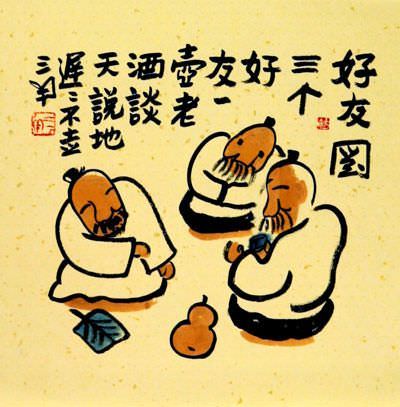 From the ancient temples of the Middle Kingdom to the epoch of the modern era, it has echoed the cry of nature and infused the spirit of its forefathers. Neither reducing nature nor augmenting it, rather assuming a synchronous synthesis of harmony and balance. A balance that flows with fluidity, akin to the water trickling down a stream; analogous to the bamboo rod that bends yet reverts. A grand scheme of things that pursues the metaphorical over the analytical and the relative over the absolute. It is the definitive unity of the macrocosm and the microcosm, a universal endeavour bound by a timeless and unparalleled cultural phenomenon. Chinese philosophy offers an incredibly poignant, intrinsic and soulful approach to the metaphysical and beyond; compounded with its lucidity and countless oriental flavours. Subsuming the cosmos into the five elements, Wu Xing, it pursues a cyclic order from rudimentary processes; for fire cools into the earth, which condenses into metal, which melts into liquid, which takes shape into wood, which kindles into fire. Chinese philosophy is a constant yearning for polarity, taking the Wu Xing and forming a partition between its Sheng and Ko, construction and control, dimensions. But the sheer genesis, the underlying reality remains the Dao, the revered yet unknown way of the universe; for the Dao creates the universe yet it is not separate and although one may name it, one has not found it. Such an inexplicable transcendence proves the answer to the occidental equivalent of metaphysics, as well as the very pathway by which the lifeblood of the cosmos circulates and permeates, Qi. The envisaging of Qi as energy focal point, the vibration and the trigger behind matter and energy, it is philosophical and mystical reality recognised not by what it is but rather by what it does. Elaborating on the yearning for polarity, the Chinese tradition recognises a reality substantial to the world and lives and minds, the great tension between opposite forces, the mutual duality of Yin and Yang. Such a duality is one that is viewed as neither two nor one, is envisioned as both static and moving as well as the annihilation of the absolute. Such is contrasting face to the occidental view of the Yin and Yang as polarities of good and evil, rather one should observe the Yin becoming the Yang and vice versa. The Chinese philosophical tradition forms a unique junction between mind and matter, between thought and the somatic half of things. Outlining the various channels and meridians by which Qi is conveyed through, as dictated by the strive for balance of Yin and Yang, as governed by the elemental unity of the Wu Xing and directed by the will of the Dao. A grand philosophical tapestry, woven in it the fabric of sagacity and the appeal towards nature as the grand teacher and master; the avoidance of absoluteness and a thoroughgoing shift from the occidental tradition.
Subscribe to:
Posts (Atom)