
Tuesday, 2 July 2013
Neutrinos- Massive After All

Sex- A Gene's Eye View

Friday, 21 June 2013
Cambrian Explosion- A Missing Link?

Saturday, 8 June 2013
Human Evolution- Our Ancestors' Tale

Wednesday, 29 May 2013
Time- A Traveller's Guide
 This moment is priceless. Or is it? You feel as if it began out in the future, suddenly became the present and will soon be dismissed into the past. But what if our common sense was less sensible than we ever envisaged? What if our deep down, fundamental intuitions about the fabric of reality were somehow flawed? Time is no exception. Throughout human inquiry, it seems to have lost its flair and panache as a measure of all things causal; Newton liken time to an undeviating arrow, a master clock, but it was Boltzmann who proved that the laws of motion work just as well in reverse and the discrimination between past and future is nothing more than the result of a thermodynamic asymmetry (we remember the past because of its state of low entropy). Einstein comes along and crushes the notion of absolute simultaneity, showing that two observers traveling at different velocities have disagreement regarding where and when events take place despite being unanimous to the space-time coordinates. He then smashes the Newtonian idea of synchronised time, noting that gravity can distort it and the universe cannot governed under a single chronological parameter. The fall of time as an illustrious entity is furthered with a final blow to our common sense of its 'flow'; the present moment or 'now' seems to move in the future direction and our consciousness seems to leap from one moment to the sequential one. But this is silly! (Let's try a thought experiment). Imagine a dart fired into the air, we like to think of time as a line with the motion of the dart captured in a set of successive snippets or photographs stretching out from past to future. Now we circle an arbitrary point as the 'present moment'. But hang on. This is deceptive as it shows the present as stationary and popping into being at a particular instant and disappearing soon after. Our common sense tells is us the present moment is moving into the 'open' future, so lets we circle all the photos of the dart's motion to satisfy this condition. Now the motion of the dart is better envisioned but the flow of time becomes an illusion, there is no objective present moment except a subjective one. Circling all the photos of the dart's motion reveals that we don't really experience time passing; we just conjure variations between present realisations and present memories of past realisations and to give the illusion that time flows or that the present moment moves via time. So there is no moment that is privileged to be more 'now' than any other moment just like no position is privileged to be more 'here' than others as David Deutsch put it. But the possibility of time travel emerges, one that was once been reserved for the likes of H.G. Wells and Back to the Future, with plutonium fueled Deloreans and Star-Trek warp drives dominating the silver screen. However, we are all time travelers at a lowly rate of one second per second (still not satisfied?). You could travel into the future by boarding a space-craft, traveling near the speed of light to a distant galaxy, slowing, and then turning back and traveling near the speed of light to earth. But what about going to the past? General relativity allows paths in space-time where proper time reverses or loops back upon itself into the past, such closed time-like curves (CTCs) may be the ultimate candidate. But other solutions like Godel's rotating fluid universe (if you walk along the direction of rotation you would end up back where you started but backwards in time), Gott's cosmic strings (topological defects caused by phase transitions in early universe) and Kerr's worm holes stand out as equally probable. In fact, certain anomalies such as the grandfather and information paradoxes have forced some to propose a protected chronology postulate. However when we combine quantum teleportation with post-selection, we get a CTC with the ability to choose what types of states may be teleported and by extension, preventing a particle or person from preventing their existence from the word go in principle just as Novikov's self-consistency condition avoids paradoxes by making their probability zero.
Thursday, 16 May 2013
Gravity- Taking a Quantum Leap
 Gravity. It's what makes the tides come in and out, what makes the sun go up and down. Yet it's nothing more than matter telling space how to curve and space telling matter how to move; a universal force arising from a universal dialogue. But among the holy grails of modern physics, the challenge of marrying quantum mechanics (QM) with general relativity (GR) is proving just as quirky as placing square pegs in round holes. One where loops, strings and twistors go head to head to unearth gravity at the quantum regime; where our current picture of space-time may potentially transfigure and where theory of everything may eventually, finally catch up. Let's start at the start. Once upon a time Newton looked at space as a sort of stage or fixed background on which matter moves, then Einstein showed in GR that gravity necessitated explanation in terms of a field that then emerged as the 'fixed background' that Newton proposed; the acceleration in F=ma became a part of a field entity and not an absolute view of space. Einstein had checkmated the Newtonian view, there is no background space-time. From then on, it becomes easy to see how QM views the gravitational field in terms of a discrete, grainy and granular framework where the 4D continuum is broken (a sort of 'fields over fields' and not on background space). The unfavorable encounter with ultraviolet divergences in quantum field theory has seduced many to the idea that strings are the thing to better unite QM with GR, assuming the extravagance of extra compactified dimensions, super-symmetry and even proton decay; but string theory ain't the only game in town. When we consider Faraday's own field concept as a variable in Yang-Mills theory, they become excited fluctuations of the quantum field and form closed loops when there are no charges; they are probably also excitations of the gravitational field. Here loop quantum gravity (LQG) comes to the rescue as a background independent format with no need of unification and super-partners for particles; the loops cross over at nodes forming spin networks, with each node constituting a monomer of space, hence Newton's picture is substituted with spinfoam (the histories of the spin networks). Space becomes the spin network and the space-time becomes the spinfoam, where the histories of points, nodes and lines are surfaces or faces become connected; it's an approach very similar to Feynman's formalism of summing over histories, here we sum over the possible geometries and get rid of the divergences into infinities caused by perturbative quantum field theory. The loops are space per se and a state of space is therefore defined by a network of intersecting loops. Another road to quantum gravity is one championed by Penrose, the so called twistor: initially we thought of spinors at the lego bricks of discrete space-time as they distinguish between different spins, indirectly implying they can generate their own spaces. But an entity was needed to combine the notion of spin with linear momentum, in other words it must be an entity moving and rotating along with quantum and relativistic properties, hence the twistor. Penrose combined the concepts of rays of light and complex numbers to create a 'twistor space' as an analogue to space-time, like the spinfoam in LQG, a Riemann sphere represents all the possible histories of light rays. Here the sequences of events don't vary and fluctuate as one would expect from the quantum scale but instead the timing and location of events change in twistor space. As for real-world applications and tests of such theoretical frameworks, we can expect breaches of Lorentz invariance (different wavelengths of light travelling at varied velocities), a possible elimination of the initial singularity (as attempted by the Hartle-Hawking proposal), explanation of the inflationary era of the early universe, insight into black hole temperature and entropy in addition to greater insight as to what what the planck scale really looks like.
Monday, 29 April 2013
Antimatter- Something Rather than Nothing

Saturday, 27 April 2013
Topology- From Euler to Poincaré

Friday, 19 April 2013
Dark Matter- A Standard Model of Cosmology
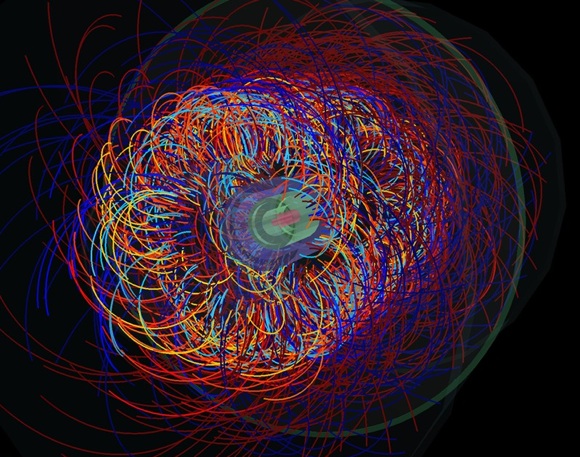 We lie off-centre in the disk that is our Milky Way. A crowd of a hundred thousand million stars, accompanied by globular clusters embedded in a galactic halo kilo-parsecs across. We are part of the local group, a community of galaxies with our closest neighbor, the Canis Major Dwarf and our twin, Andromeda. And while a GPS won't get you far in an increasingly homogeneous and isotropic universe, we are only beginning to peel back the layers of the cosmic onion. We see it's expansion via the receding of galaxies, the meandering of supernovae through standard candles and their speeds by their red-shift. But an anomaly remains on how to account for the accelerated expansion in conjunction with attractive gravity. Dark matter is the 'stuff' of the universe that pulls things together via its attractive gravity and boasts thirty percent of it. It's dark, bleak and invisible but when you consider the cluster dynamics of galaxies for instance, there seems to be more mass determined by velocity rather than what can be accounted by with observation. Gravitational lensing also hints it's existence where the curvature of space-time near a mass deflects light and distorts images of background galaxy clusters. We can rest assured that non-baryonic WIMPS, weakly interacting massive particles, are the ideal candidates for exotic dark matter species as opposed to baryonic MACHOS or massive compact halo objects. There may even be no dark matter but rather modified Newtonian mechanics on an intergalactic scale, rogue planets, black holes or even mass challenged dwarf stars. On the flip side, dark energy pushes things apart, exhibits a repulsive gravity and brags seventy percent of the cosmos. An all pervading fluid as envisioned by the Friedman-Robertson-Walker models will be a source of positive pressure at every single point and would drive deceleration of expansion, however dark energy exerts negative pressure to accelerate expansion as inferred from CMB anisotropies. Think of the Casimir effect, when two closely partitioned metallic plates in a vacuum attract each other, arising from the influence that the plates exhibit on the space between them and the effective negative pressure produced. Indeed Einstein's 'greatest blunder' may be a contender for dark energy; matter and energy under the cosmological constant will not be impaired by expansion but would remain uniform and release negative pressure. Moreover, the energy of the quantum vacuum may be another contender; given that vacuum energy is intrinsic to the vacuum, it won't be diluted by expansion and would exert the required negative pressure. Finally, cosmology is topped off with inflation; the hot big bang model presents two unique limitations: the flatness and horizon problems. Stated simply, the universe is essentially flat with a curvature parameter k of 0, the CMB is the same temperature in all directions and Grand Unified Theories predict an abundance of relic magnetic monopoles. Inflationary cosmology tells the tale 10^-36 seconds after the bang where the scale factor of the universe inflated exponentially, solving the problems by smoothing out any rough edges and separating regions with the same temperature across large distances and diluting any relic particles. The source of cosmic energy for such an initial singularity may be resolved via t=0, given that the total energy of the universe is 0 as the gravitational field has a negative quantity; thus cancelling out. And the universe is largely a 'nothing' for 'nothing' phenomenon, we are merely a speck in her finite yet unbound being.
Tuesday, 16 April 2013
Morphic Resonance- The Presence of the Past
 They are the organising fields of self-organising systems. The habitual blueprints of pattern and form and the inherent collective memory strung across space and time. Morphic resonance remains a hypothesis of formative causation, one where the field concept is extended upon the biological realm and presents an evolutionary account of instincts and behaviors. One where the laws of nature become manifestations of acquired habits, where developing embryos become products of an architectural, morphogenetic plan and one where flocks of birds and schools of fish orient themselves in a seamless fashion via morphic fields. Just as a bar magnet can be split into infinitely many smaller magnets, each with their respective north and south poles; the holistic rather than mechanistic nature of living systems, especially in their developmental stages is reminiscent of the field. Matter is not fundamental to such fields but rather conversely fields are fundamental to matter.Take the embryonic development of species from flat and nematode worms to dragon flies and newts; terminating the growth of one half of the embryo will allow the other half to grow independent of it as if a mechanism beyond bilateral gene expression and modulation is vested. Willow tree cuttings and amputated newts grow readily as if a morphology in the form of a field, where nested hierarchies of holons centered on lower level systems govern their self-organising behavior. Morphic resonance is the inference from similar patterns of form acting on subsequent patterns of activity, a kind of collective unconscious comparable to that proposed by Jung. If rats in San Francisco learn a new trick then rats in London should learn such a trick more readily and with ease; similarly, the synthesis of a new crystalline compound more often yields easier crystallisation rates in the future. Such phenomena may be deduced from the presence of the past, a sort of collective-rat memory, a morphic field rather than coincidence or fragments travelling on the beards of migrant chemists. Homoeotic mutations in Drosophila fruit flies produces extra wings in the place of halteres, such a tuning into the morphic field of the fly revisits the heresy of heredity whereby acquired traits may have the potential to be inherited. Indeed the anthropocentric notion of physical laws or constants are somewhat outrun by the idea of habits, verily human laws evolve and change with time and so could the laws of nature arise via habitual means of non-local reinforcement of similarity and natural selection. Similarly, the same means by which a magnetic field stretches beyond the horizon of a magnet and the gravitational field of the sun reaches out to keep the planets in orbit; the extended mind reaches out beyond the vicinity of the physical brain, a morphic field between minds and thoughts. But in the long run, the ascent of alternative hypotheses rather than merely mechanistic truisms spells a resonance of morphic proportions.
Sunday, 17 March 2013
Ethology- Monkey See Monkey Do

Monday, 4 March 2013
Quantum Field Theory- A Matrix of Symmetries
Subscribe to:
Posts (Atom)